Simple DVT: A Landmark in Ethereum Staking Decentralization
A historical retrospective and forward-looking strategic case for accelerating Obol distributed validator adoption in the Lido protocol.

Executive Summary
Simple DVT is graduating from its initial two year experiment, which proved that distributed validator technology, and Obol's middleware approach, runs reliably at scale, performs above the network average, helps to decentralize the network and belongs as a foundational technology across the entire Lido protocol.
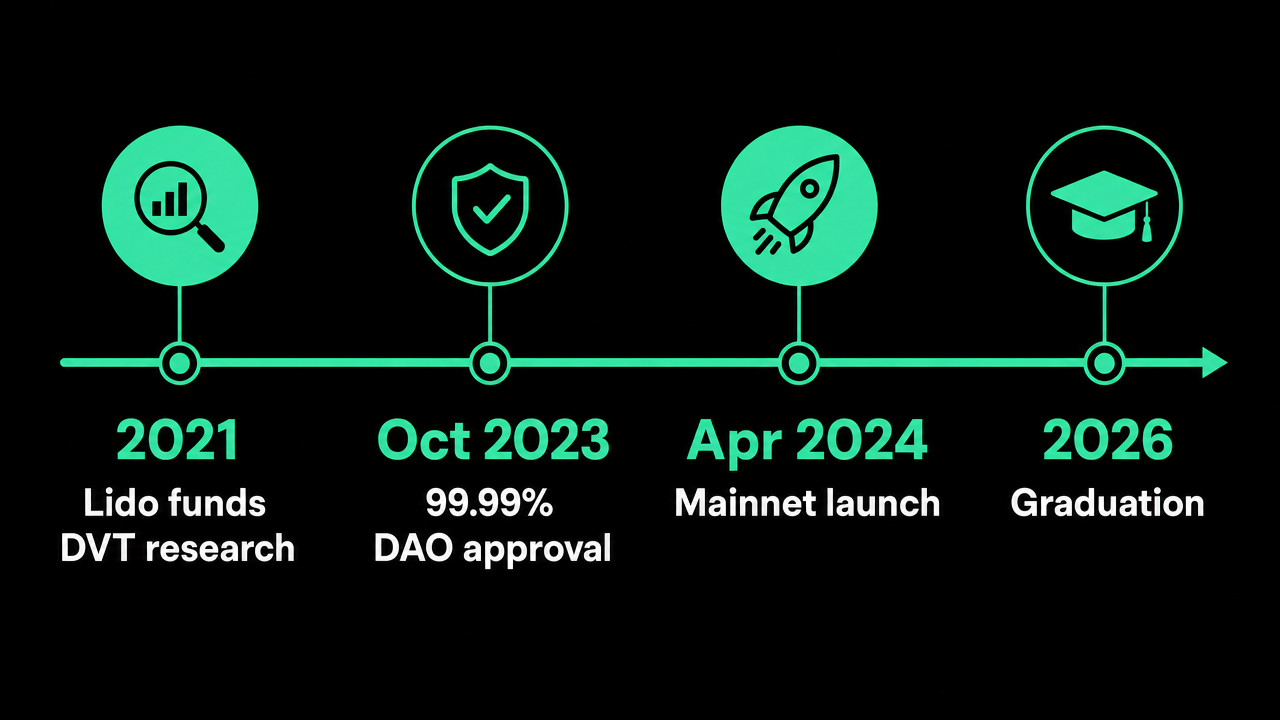
In 2021, Lido DAO committed to support DVT research. In October 2023, the DAO voted to deploy the Simple DVT Module with 99.99% approval from participating voters. The first 12 Obol clusters went live in May 2024. By mid-2025, 323 operators across 32 countries were running validators through the Simple DVT Module and beating the Ethereum network average on performance and reliability. By the end of Q4 2025, more than 22,000 DVT validators, run by Obol and SSV Network operators across all Lido modules, were covering close to 2% of all staked ETH. Now in 2026, Simple DVT is graduating and Obol Distributed Validators will play a critical role across the entire Lido protocol.
Looking backward:
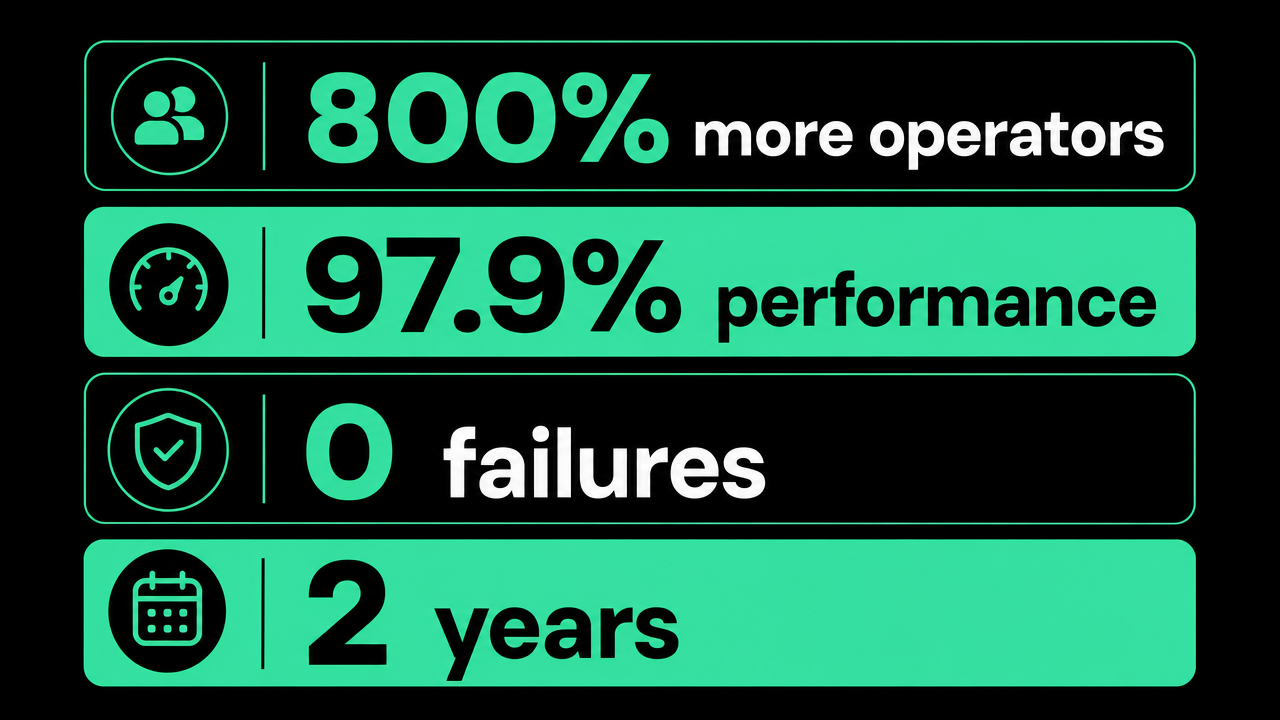
- The Simple DVT Module grew Lido's operator set from 37 to more than 300 unique participants - over 800% growth, not counting the additional operators CSM brought in over the same period.
- Aggregate 30-day Rated RAVER hit 97.9%, above the Ethereum network average of 97.3% in the first year of Simple DVT.
- Simple DVT operators ran nodes in 32 countries.
- Compared to the first cohort onboarded, client diversity improved notably: within the module Nethermind concentration dropped 26 percentage points and Lighthouse dropped 28 percentage points.
- More than 22,000 DVT validators were running across the Lido protocol by Q2 2026.
- Zero major correlated-failure events across two years on mainnet.
Looking forward, Obol recommends the following
- Expand Obol DVT aggressively across the Curated Module - the June 2025 governance vote opened the door, and the community should aggressively prioritize this.
- Make IDVTC the default path for community stakers entering CSM.
- Treat DVT as the baseline architecture for any new Lido module or module expansion.
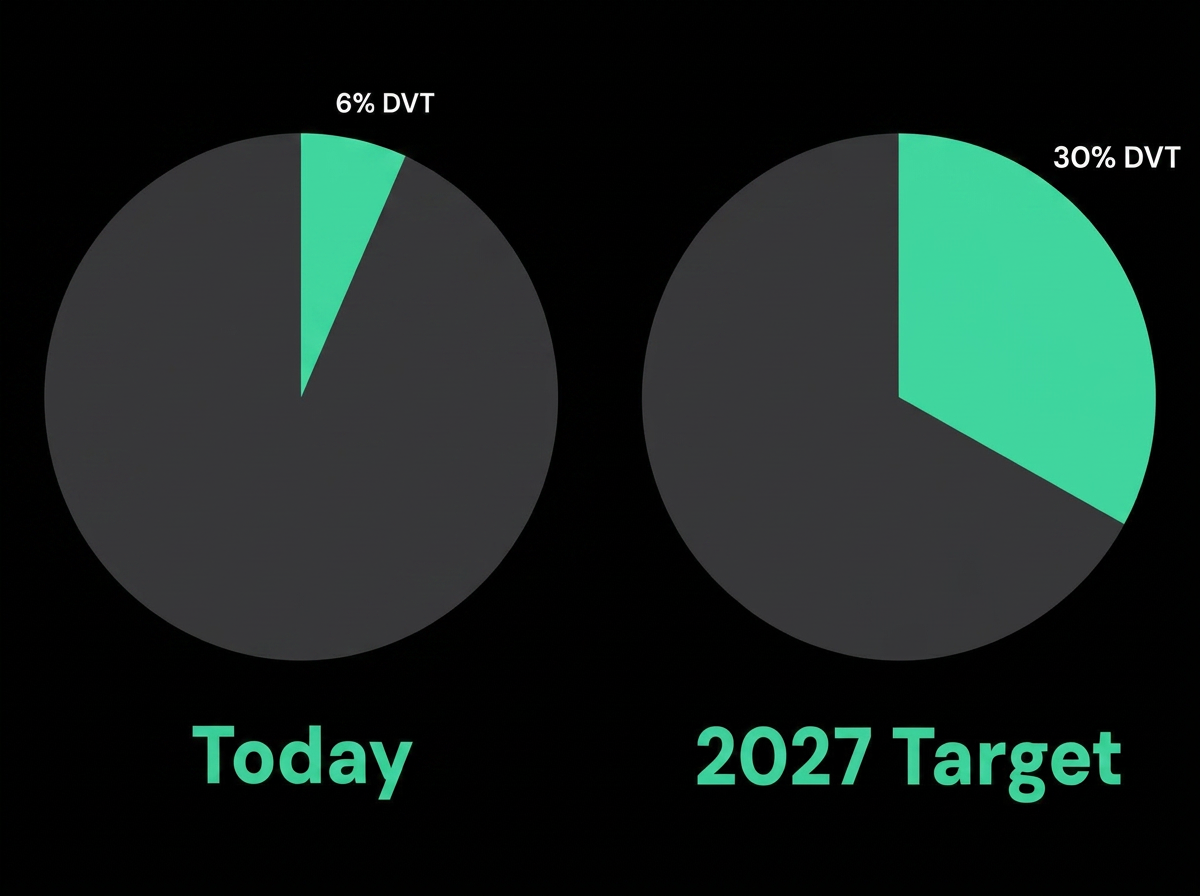
The future target we recommend: 30% or more of the entire Lido protocol running on Obol distributed validators by the end of 2027.
1. Origins and Proposal
The Problem DVT Was Built to Solve
Ethereum's move to Proof-of-Stake solved a lot of problems. But it created a new one. Validators became the backbone of the network, and validators can fail. A single operator running out of power, getting hacked, or making a configuration mistake takes their validators offline. If enough operators share the same client software, have their keys stolen by an attacker, or run their hardware in the same data center, a single bug or outage can take down thousands of validators at once. Correlated failures are a vulnerability that Distributed Validator Technology was designed to fix.
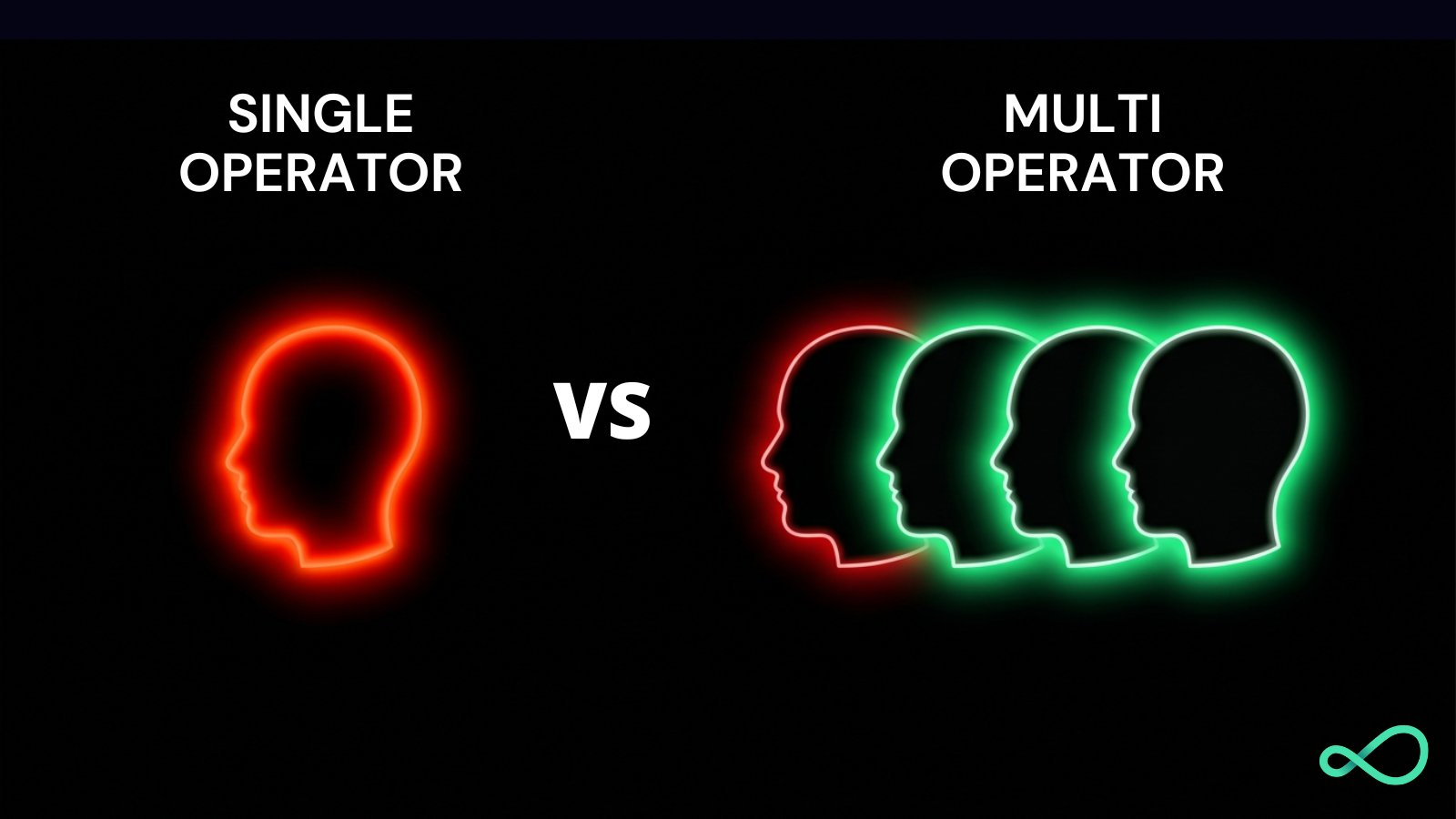
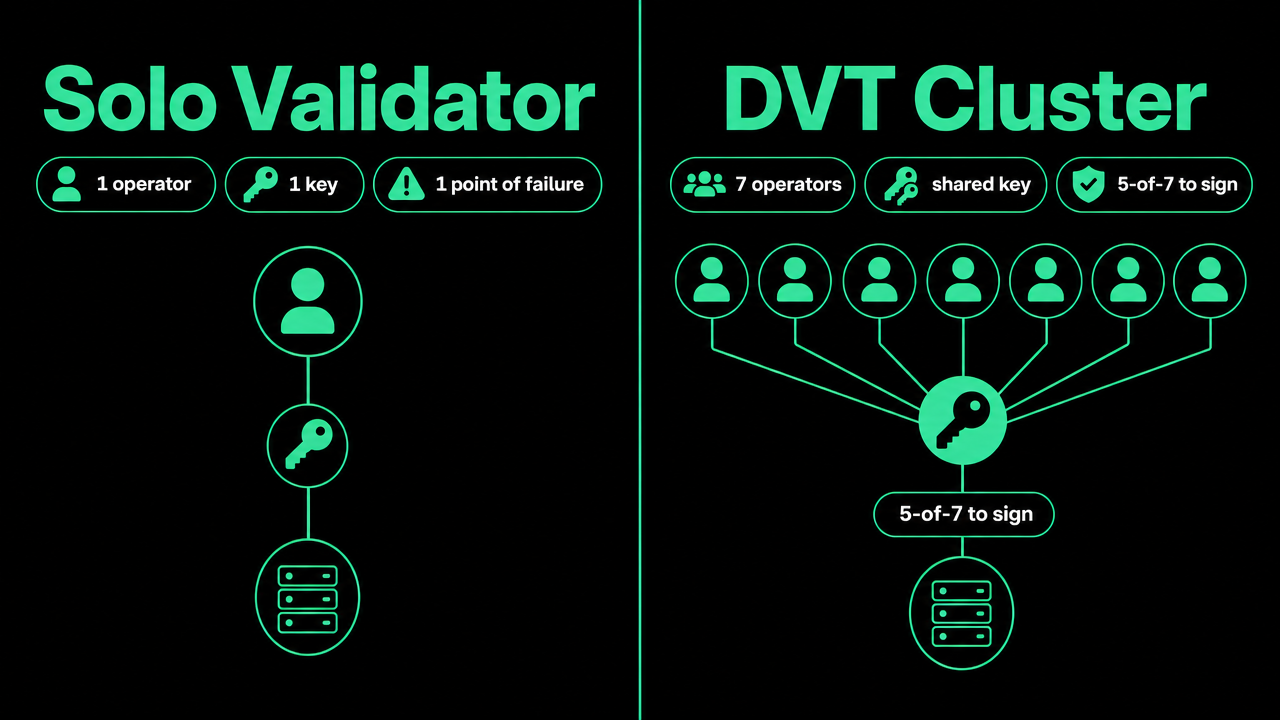
DVT treats a single validator like a shared responsibility. Instead of one node operator holding the signing key and running the validator alone, a cluster of operators (known as a squad) runs it together. The cluster needs only a majority of its nodes to agree to sign, so if one node goes down, the validator keeps running. No single point of failure. No single operator whose mistake brings everything down.
For Lido contributors and the broader Lido DAO, DVT was one answer (among others) to a serious question: how do you run the world's largest staking protocol without becoming a centralization risk yourself?
Lido's Commitment to DVT
Lido's DAO voted to support DVT research in 2021, before most of the industry took the technology seriously. That decision was made early and deliberately. Rather than pushing back against concerns about operator concentration, Lido went looking for technology that would solve the problem at the root.
The empirical work started on Görli testnet between October 2022 and May 2023, running two pilot rounds with Obol to build a real performance record before any production commitment. By May 2023, Lido's Izzy (previously Master of Validators, now Chief of Staking at Lido Labs) and Obol's Oisín Kyne (CEO & Cofounder of Obol) appeared on the Bell Curve podcast to lay out publicly why DVT inside Lido represented an architectural shift for not only Lido but Ethereum staking at large.
The Staking Router Made It Possible
Simple DVT couldn't have shipped without the architectural groundwork Lido laid with The Staking Router, a modular contract layer that lets multiple validator modules coexist inside the protocol. It meant a DVT module could plug in as a first-class participant without requiring changes to the core Lido contracts. That same flexibility is what now lets DVT expand into CSM and any future module the DAO deploys.
The Proposal and the Vote
In July 2023, Will Shannon (Head of Node Operator Mechanism at Lido Labs) posted the Staking Router Module Proposal: Simple DVT to the Lido Research forum. It became one of the most engaged validator-module proposal in the Lido governance history with 139 replies and 27.2k views. The forum debate worked through every material parameter: 7-participant clusters, a 5-of-7 signing threshold, an initial 0.5% stake cap, governance through an Simple DVT Module Committee and Easy Track motions, and fee splits of 2% to treasury and 8% to the module.
On October 26, 2023, the Snapshot vote passed with 99.99% approval. December 18 brought the first dedicated Simple DVT Node Operator Call with Lido contributor Will Shannon. On February 23, 2024, the on-chain Aragon vote passed, formally releasing the module to mainnet. The experiment was about to begin in earnest.
2. The Technology: Why Charon's Middleware Is The Right Design
How Charon Works
Obol's DVT client, Charon, sits between a node operator's consensus client and validator client. It doesn't replace either. Operators keep their existing software, their preferred execution client, their preferred consensus client, and Charon layers in to coordinate signing responsibilities across the cluster.
That design choice matters. Most DVT approaches require operators to change their stack. Charon doesn't. It slots in as middleware and handles the distributed signing work without operators noticing. From the validator client's perspective, it's talking to a single consensus client. In reality, it's talking to a cluster of independent nodes that must reach agreement before any signature goes out.
No Single Point of Failure
The practical result is active/active redundancy across every cluster. Simple DVT used a 7-participant, 5 of 7 threshold configuration. That means five of the seven nodes in a cluster must agree on any given attestation or block proposal before it's signed. Two nodes can go offline simultaneously, hardware failure, power outage, software crash, anything, and the validator keeps running without interruption.
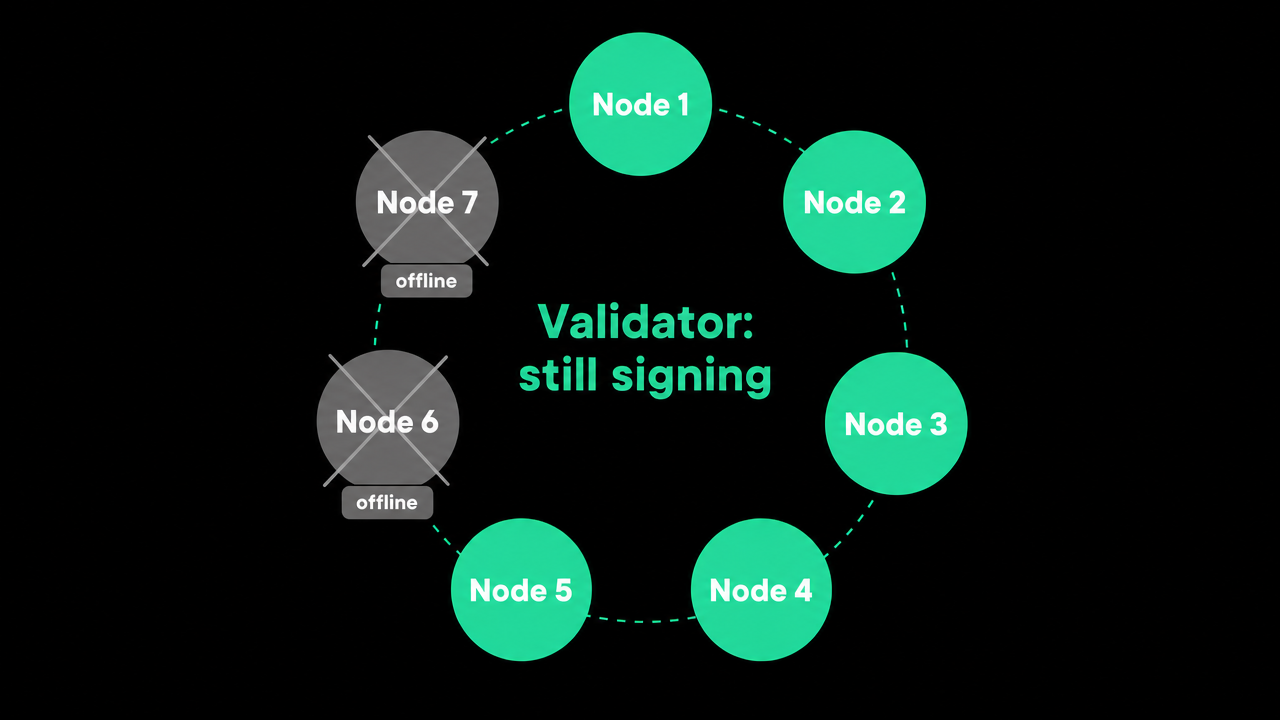
That's a fundamentally different risk posture than solo validation. A solo operator goes down, their validator misses duties. A DVT cluster loses two nodes and nothing changes on-chain.
Key Security Through DKG
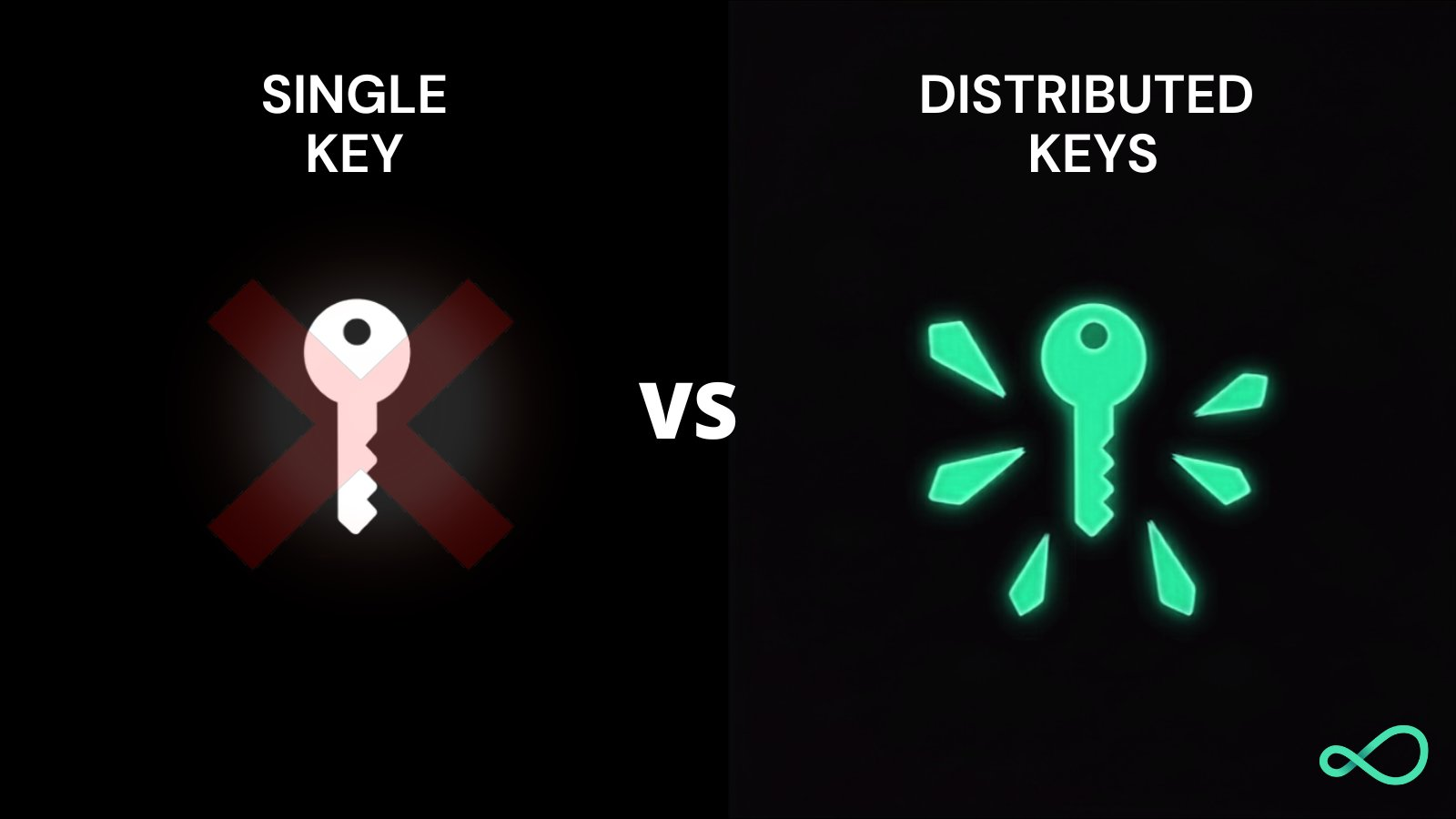
Distributed Key Generation is how Charon handles the private key. The full BLS validator key never exists in a single place. During cluster setup, the key is generated in a distributed ceremony where each operator ends up holding only a key share, never the whole key. No single operator can sign alone, and no single breach can expose the full signing key. ENR private keys for node identification are separated from validator signing keys entirely, closing another attack surface.
Client Diversity as a Resilience Property
Each of the seven operators in a cluster runs their own independent software stack. Different execution clients, different consensus clients, different validator clients. A bug in Nethermind doesn't affect an operator running Geth. A consensus client issue with Lighthouse doesn't touch an operator running Teku. That independence is a fundamental design benefit of Obol's DVT.
3. Testing and Launch
The Holesky Testnet
Before a single validator went live on mainnet, Lido and Obol ran 69 days of testing on the Holesky testnet - November 3, 2023 through January 22, 2024. 32 distributed validator clusters, 214 participants, 3,100 validators. Each cluster used the same 5 of 7 threshold configuration planned for mainnet. Validator counts scaled progressively: 5 keys per cluster, then 50, then 100.
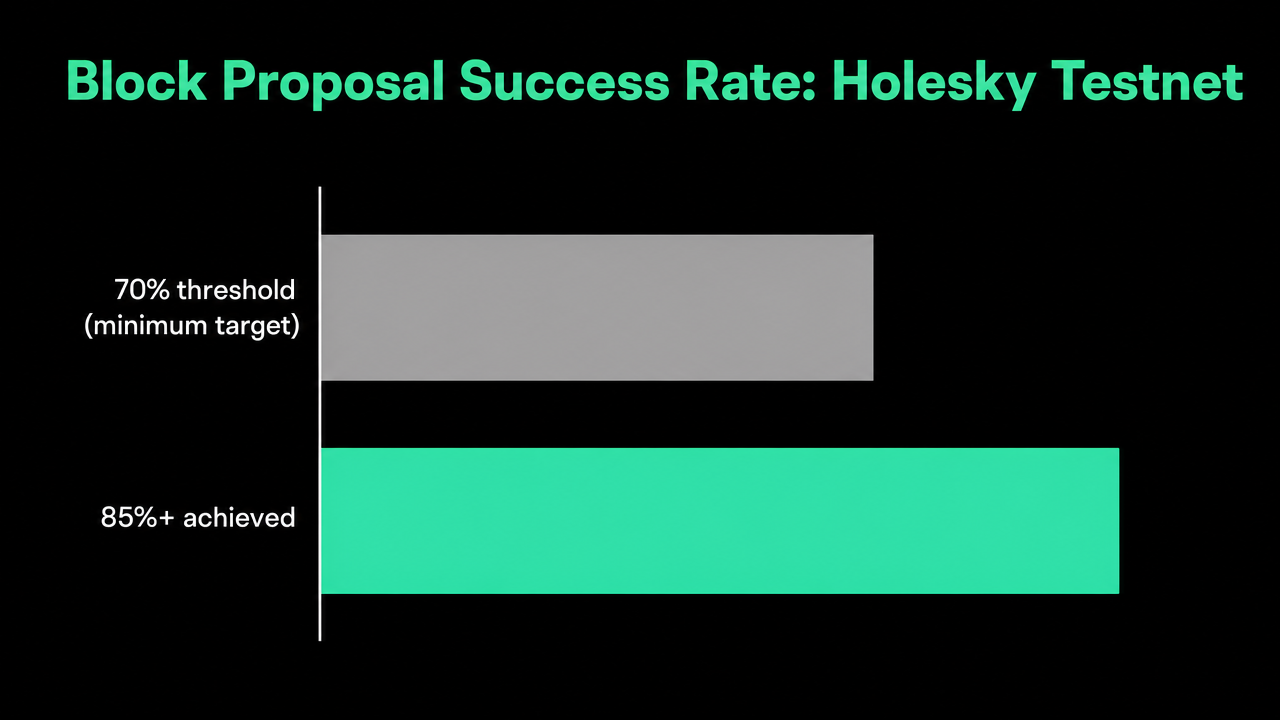
The aggregate results cleared every minimum benchmark set in the original proposal. Uptime came in at 97.93%. Attestation effectiveness at 84.53%. Block proposal success rate hit 71.17% for the monitored period - above the 70% threshold - and climbed above 85% in the final week. Top performing clusters held a 100% proposal rate across the entire test. You can read the full testing breakdown in Obol's Wave 1 report and Lido's blog post .
The trial also surfaced real operational learnings. Intra-cluster latency above 235 milliseconds hurt performance, especially for clusters spanning multiple continents and operators in Asia Pacific. Underpowered hardware - low spec VPS instances, spinning disk storage - caused beacon nodes to fall out of sync as validator counts increased. MEV-Boost relay selection mattered more than expected, with some relay configurations adding over two seconds of latency to block proposals. All of these became explicit mainnet requirements: hardware minimums, geographic cluster tuning, and deliberate relay configuration.
Mainnet Launch
On April 16, 2024, the Simple DVT Module went live on Ethereum mainnet. The first 12 Obol Cohort 1 clusters - named Azure Albatross, Bountiful Bison, Covert Cougar, and nine others - began accepting ETH deposits. New depositable ETH entering Lido routed to the Simple DVT Module first, giving the new operator set priority until it reached capacity.
The composition of those first clusters told the story of what Simple DVT was actually for. Four distinct operator groups ran validators side by side: Curated Module Node Operators, Advanced Node Operators (ANOs), community staking groups, and home stakers. ANOs were a classification introduced in the original Simple DVT proposal for participants who demonstrated consistently strong performance, both qualitative and quantitative, during SDVT testnets and on mainnet, with strong alignment to the broader Ethereum staking ecosystem. For the first time, professionals and novices were collaboratively validating to better secure and decentralize Ethereum.
By the end of the first two Obol cohorts, the module had brought in 139 net new node operators: 70 solo stakers, 28 community stakers, 41 professional operators, and 22 existing curated-set members running in DVT clusters for the first time. Added to Lido's existing 37-operator curated set, that was a near 400% increase in the number of operators running mainnet validators through the protocol.
CoinDesk, The Defiant, and The Block all covered the launch. Messari named the Simple DVT Module activation a quarter-defining event in its Q1 2024 State of Lido report. The consistent framing across all coverage was the same: this was Lido's most credible structural answer to the Ethereum decentralization debate.
4. Performance Data: DVs Outperform Legacy Validators
The DAO Doubles Down
Three months after mainnet launch, the data was strong enough that the DAO voted to expand the module stake share. In July 2024, a on-chain vote raised the Simple DVT Module's stake-share cap from 0.5% to 4% of total Lido stake - an 8x increase. The vote also introduced Super Clusters: DVT-powered clusters composed of Advanced Node Operators and Curated Module members, designed to run up to 500 validators each.
Year-One Numbers (as of June 27, 2025)
By the one-year mark, Simple DVT had grown into something much larger than the original proposal anticipated.
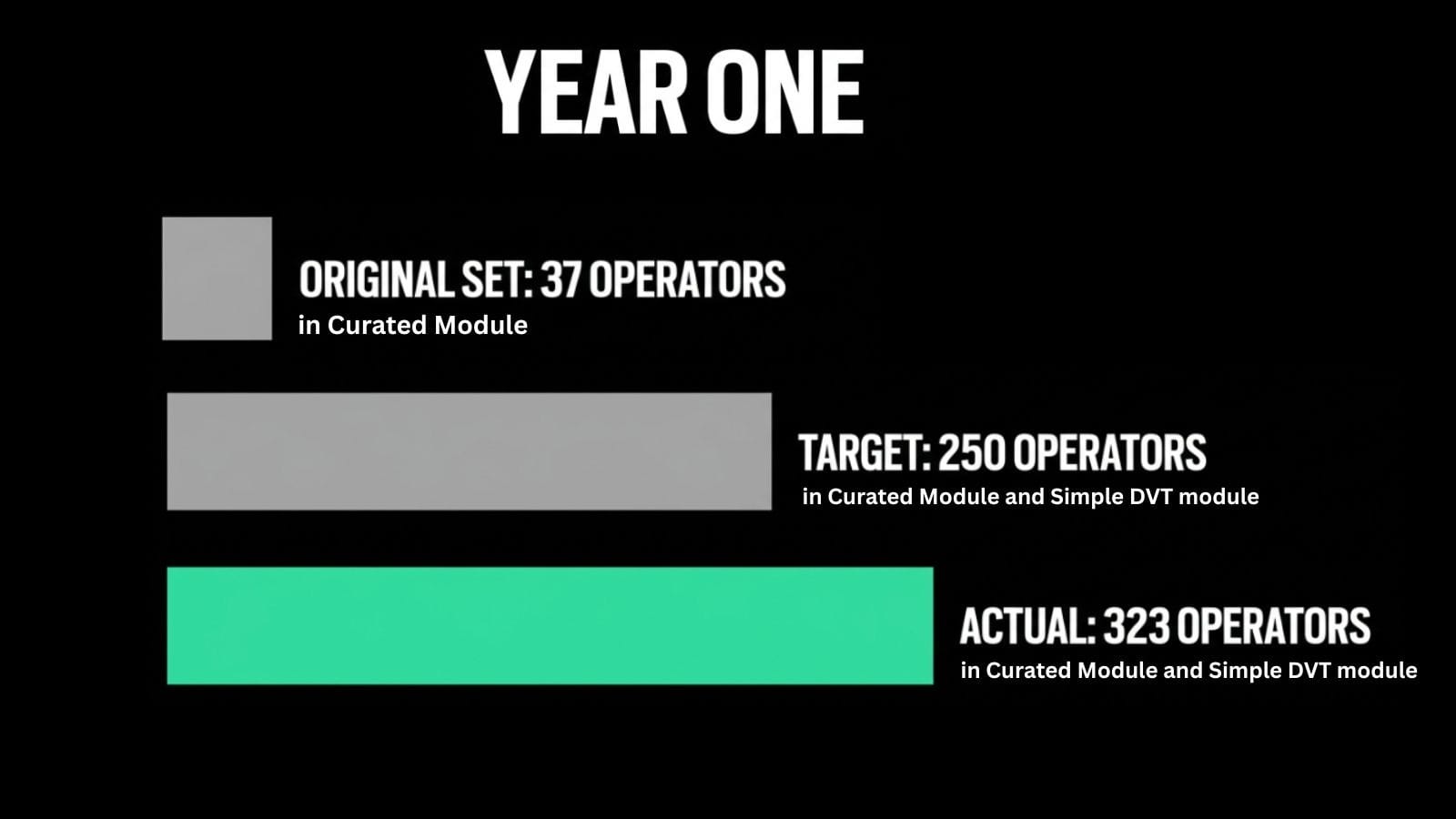
Across the module’s full life, 323 unique operators participated, with nearly 300 of them net new to the Lido protocol. That was a 53.8% beat on the original 250-operator onboarding target, and an 800%+ increase over the original 37-member Curated Node Operator set. Operators came from 32 countries across North and South America, Europe, the Middle East, Asia, and Australia.
At the one-year mark, Simple DVT operators ran 308,320 staked ETH - 3.39% of all Lido protocol deposits and 0.88% of total Ethereum stake. Average validator counts stood at 64.4 per regular cluster and 500 per Super Cluster. The Gini coefficient - a measure of validator concentration per operator - held at 0.4651, reflecting moderate, stable distribution.
DVs Outperform the Network
The most important number in the entire module performance is also the simplest. On its first anniversary (June 2025) the Simple DVT Module's 30-day aggregate Rated RAVER was 97.9%. The Ethereum network average over the same period was 97.3%. Simple DVT outperformed the broader Ethereum validator set.
Over that same 30-day window, the module accumulated 607.36 ETH in combined consensus-layer and execution-layer rewards, at an average APR of 3.07%.
Across all 13 months, the median monthly participation rate was 100%. Average monthly participation held between 96.6% and 99.9%. Average validator effectiveness ranged from 97.1% to 98.6% across all normal operating months, with the exception of February 2026, which showed an anomalous dip to 91.6% before recovering fully to 97.9% in March and 98.4% in April. No month showed signs of correlated degradation - the variation tracked with broader network conditions, not DVT-specific failures.
Client Diversity: Real Decentralization
When Simple DVT launched, Nethermind held 78.6% of the execution-layer client share inside the module's first clusters. By the end of Q1 2025, that had fallen to 58% - a 20.6 percentage-point reduction. Geth gained 11.1 percentage points. Besu gained 7.7 percentage points. Reth appeared inside the module for the first time in Q1 2025.
On the consensus layer, Lighthouse held 77.4% of the share among the first cohorts. After all cohorts were onboarded, that dropped to 56% - a 21.4 percentage-point reduction. Teku, Prysm, and Lodestar all increased their presence in the mix. The module also showed the presence of true home-node usage unlike the Curated Module, with community and home stakers making up more than 50% of all SDVT operators.
Year-Two Data: The Scaling Continues
By Q3 2025, the Simple DVT Module hit its 4% stake cap with all 82 clusters fully allocated. The Community Staking Module hit its 3% cap at the same time. Together, SDVTM and CSM covered roughly 600,000 staked ETH inside Lido. On July 10, 2025, Lido contributor Dmitry Gusakov noted publicly that CSM and SDVT combined had become the 10th-largest ETH staking pool by size.
The performance picture across the full second year held firm. Across 13 months of data from June 2025 through June 2026, the median monthly participation rate was 100% every single month. Average validator effectiveness ranged from 97.1% to 98.6% across normal operating months. February 2026 was the one exception, an anomalous dip to 91.6% that recovered fully to 97.9% in March and 98.4% in April. No month showed correlated degradation across the cluster network. The variation tracked broader network conditions, not DVT-specific failures.
Two years in. Zero correlated failures. Performance above the network average.
5. What’s Next for Simple DVT
Why Wind Down Now
On May 18, 2026, Lido contributor Will Shannon posted the proposal to wind down Simple DVT's 72 regular clusters starting July 1, 2026 - roughly ten months ahead of the originally stated two- three-year window.
The regular-cluster model worked as a battle-testing mechanism. It was never designed to be a permanent economic structure. Two years in, the math had become difficult for participants. Each operator in a regular cluster earns 1% of staking rewards from 80 validators - the 10% protocol fee split across seven participants, the DVT provider, and the DAO. At current ETH prices and with staking rewards compressing as total ETH staked grows, a significant portion of the participant base is at or near break-even.
From a protocol economics standpoint, the regular clusters were also the lowest-margin operation in Lido. Regular clusters carry a 2% DAO fee, compared to an above-6% average across other protocol modules. Super Clusters run at 4%. The module's effective blended DAO fee rate sits at 2.956%. This was acceptable when Simple DVT launched in a stronger staking market. Two years later, with declining per-validator rewards, it was time to move forward with the next phase of Lido's DVT strategy.
What Continues, What Doesn't
The wind-down applies to the 72 regular clusters only. The 10 Super Clusters continue operating within the Simple DVT Module, covering approximately 160,000 ETH, roughly 1.8% of Lido protocol stake. That's not a footnote. Super Clusters represent half of the previous SDVTM stake share, and they stay running under the same module, with a potential migration path to another module explored in the future.
That distinction matters. The module’s largest clusters from the module stay in place. What winds down is the part of the model that was always meant to be transitional. What remains is substantial.
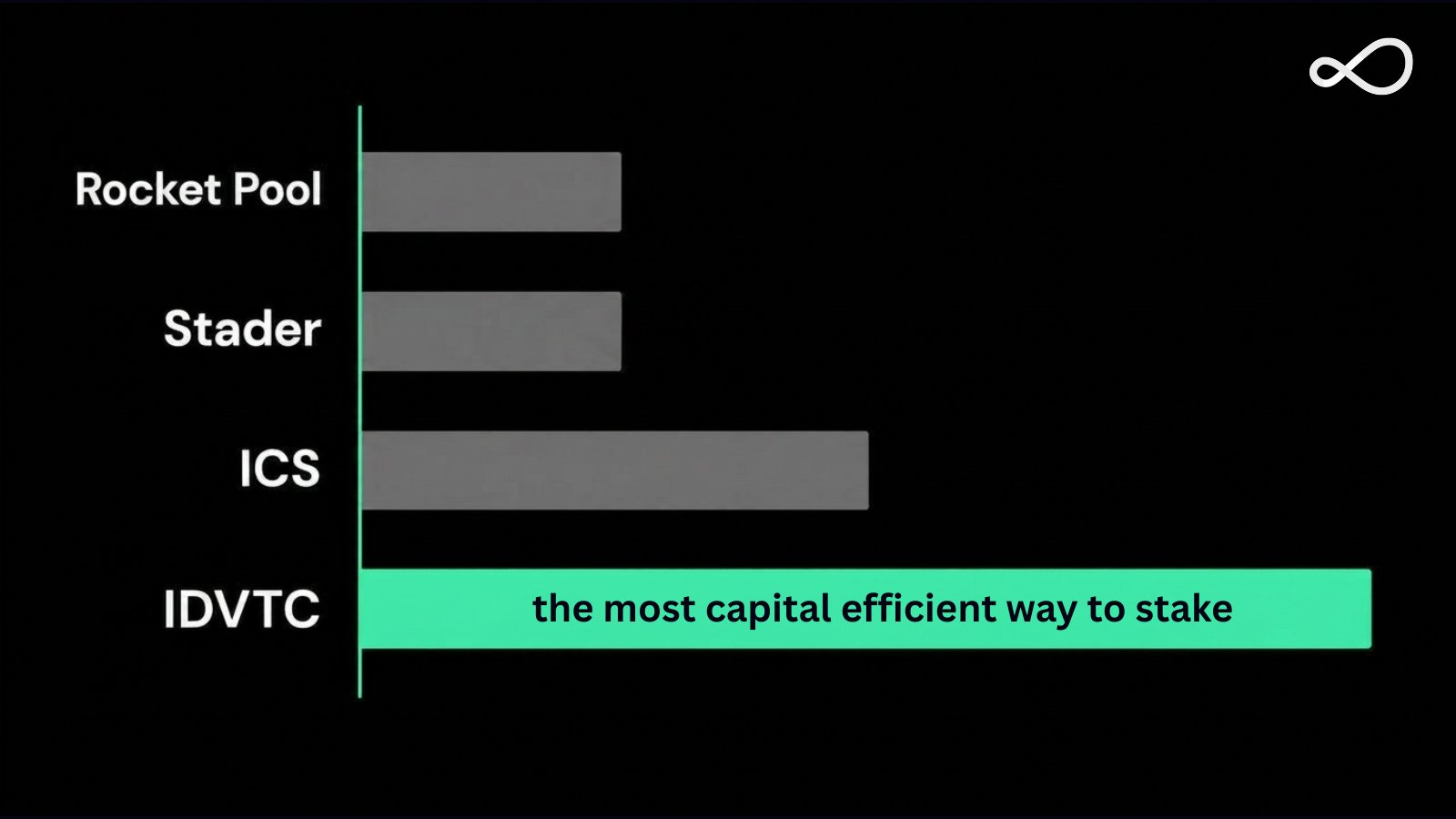
For operators from the regular clusters, the clear continuation path is the Community Staking Module via the Identified DVT Cluster (IDVTC) operator type.
6. The Future of Obol DVs in Lido
Why Obol Remains the Right Choice
Obol built Charon as a middleware - not a replacement for existing validator infrastructure, not a separate operator network with its own token mechanics, but a composable layer that any operator can adopt without rewiring their stack. Simple DVT helped Lido add 300 net-new operators without protocol-level surgery. It lets those operators bring their own client combinations, their own hardware, their own geographic diversity. And it let Charon's resilience properties - threshold signing, DKG, direct LibP2P communications - stack on top of whatever infrastructure was already there.
That composability is also why Obol is positioned to carry DVT forward as it moves into the Curated Module, CSM, and beyond.
Oisín Kyne's original mission for Obol, ensuring Ethereum maintains credible neutrality and trust-minimization despite risks of centralization and correlated failure, is exactly what Lido needs its infrastructure providers to care about. That mission hasn't changed, and neither has the need for it.
Concrete Recommendations
- Expand Obol DVT across the Curated Module. The June 2025 governance vote let Curated operators adopt DVT at scale. Obol recommends the target should be 30% of Curated validators running on Obol DVs by the end of 2027. Obol recommends the DAO to prioritize this to ensure the long term security of the Lido protocol.
- Make IDVTC the default DVT path inside CSM. The IDVTC structure is the right successor to Simple DVT for community operators. Lower bond requirements, capital efficiency calibrated to the actual risk profile of a DVT cluster, and a continuation path already populated by approximately 31 former SDVTM operators. Obol recommends that Lido contributors should treat IDVTC as the preferred on-ramp for community validators, promoting it actively at every CSM touchpoint, supporting squad matchmaking, and measuring adoption alongside ICS participation.
- Treat DVT as the baseline for any new Lido module. Any future Lido module - institutional or otherwise - should default to DVT participation as a structural assumption, not an optional enhancement. As shown in the original Simple DVT proposal, concentration risk in the validator set is not acceptable for the long term health of Ethereum, and the Lido protocol.
- Set a public target and report against it. Obol recommends that the Lido DAO should commit to a certain percentage of the entire Lido protocol running on distributed validators by the end of 2027. A public, measurable target creates accountability and signals intent. We're working behind the scenes with various staking community leaders to drive more transparency to staking operations broadly - stay tuned!
The Closing Argument
Every percentage point of Lido validators running on distributed validators is a percentage point of structural decentralization gained for Ethereum. More operators, more geographic spread, more client diversity, better key security, and fewer correlated failure surfaces.
Simple DVT ran this experiment at scale for two years and came back with clean data. Distributed Validator Technology is superior to legacy validator technology.
The next chapter isn't about whether to use DVT, it's how quickly can we give the entire network access to these structural benefits of security, performance and decentralization.