How safe is your stake? Find out with ValidatorBeat.

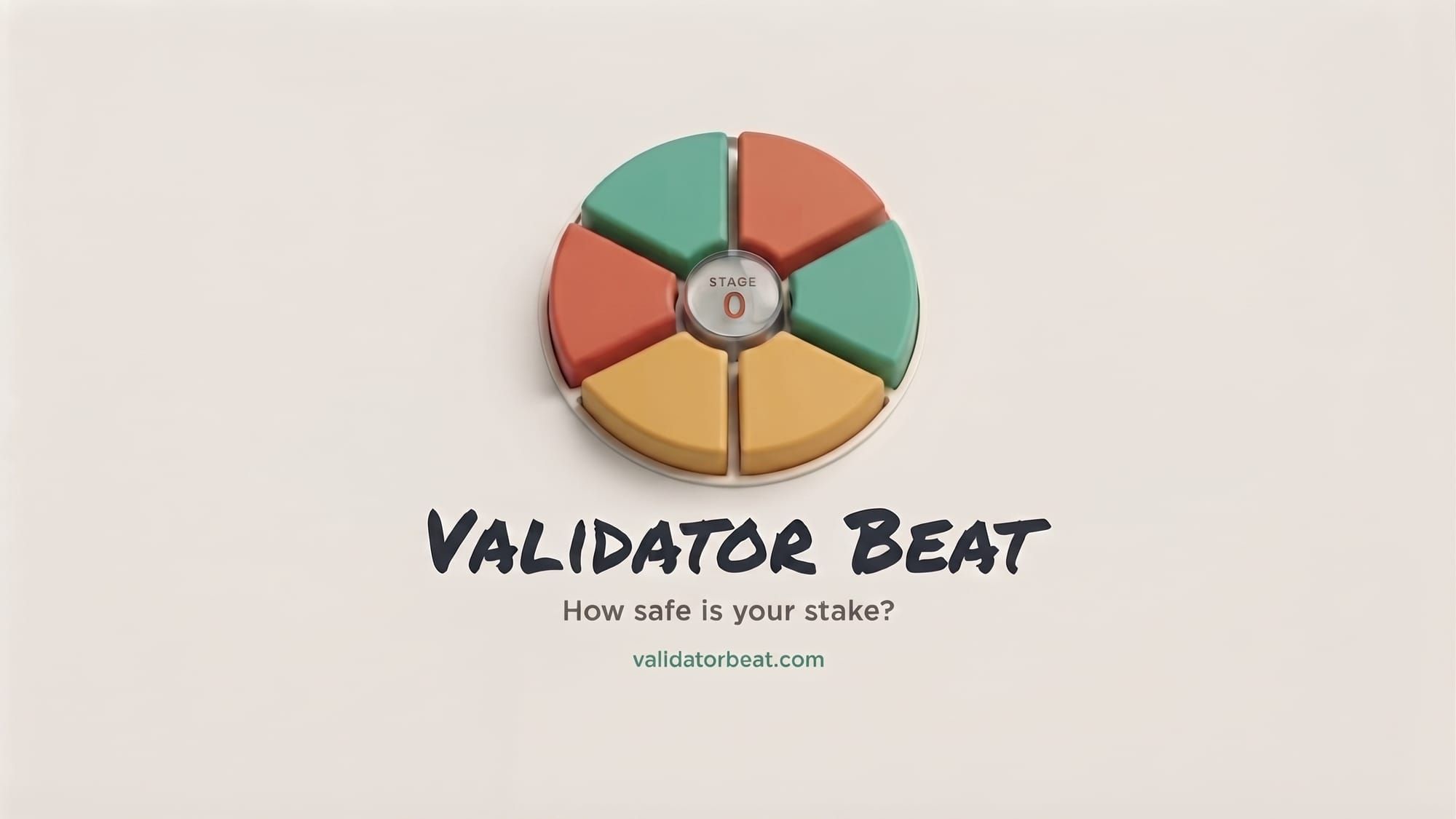
Ethereum has spent years learning to see itself clearly. Rollups have L2Beat, where anyone can check a chain's stage, its proof system, and who can pause it. Wallets have Walletbeat, which grades them on the things that decide whether your funds are actually yours. The validators securing tens of billions of dollars in staked ETH have had nothing. That is what Validator Beat aims to solve.
When you stake, you pick a Node Operator, whether or not you know it. If they do everything right, they make you a percent or two per year. If they do something wrong, they could lose it all on you. If you run a validator yourself, you are that operator. If you delegate to a protocol or a pool, an operator runs the machine on your behalf. Either way, you can see how much ETH they run. You cannot see how they hold their signing keys, which clients they run, or how correlated their setup is with everyone else securing the network. The choices that decide whether a validator stays safe and online are the ones you cannot see.
Invisible operations are unpriced operations
Staking has plenty of trust signals. Total value staked, uptime dashboards, brand names, the occasional SOC 2 badge or (self-)insurance policy. None of them answer the question that actually matters: if one thing breaks, does this validator get slashed, go offline, or keep running?
Compliance attestations cover process and custody hygiene, but to date still accept single point of failure risks in assured setups.
There are two ways a validator fails
Strip away the detail and a validator fails in one of two ways:
- It signs something it never should have and gets slashed. A double vote, or a signature on the wrong chain. This is a safety failure, and can be an expensive one. The protocol burns up to all of your stake, depending on how many other validators fail in the same timeframe.
- It goes offline and misses the duties it was supposed to perform. No slashing, but inactivity penalties are at least twice your daily revenue, and are expected to increase by multiples if selected for Ethereum's 2027 upgrade. No rewards either, and a weaker network. This is a liveness failure.
Almost every safety and liveness failure traces back to the same root: a single point of failure. One machine. One team. One client. One provider. One operating system. One region. Decentralization is the insurance against both kinds of failure, and Validator Beat measures how many single points of failure an operator has actually removed, to achieve grades their customers can understand.
How Validator Beat considers an operator
Validator Beat grades a Node Operator on six slices and places them in one of three Stages. The whole thing is designed to be read at a glance.
The six slices, each colored from the operator's own answers:
- Key Custody. How the signing private keys are held, and how many independent parties must cooperate to sign with them.
- Client Diversity. Exposure to a bug in any single consensus or execution client.
- Provider Diversity. Concentration on a single cloud or hosting provider.
- OS Diversity. Correlated risk from running a single operating system across the fleet.
- CPU Architecture. Correlated risk from running a single chipset across the fleet.
- Geographic Diversity. Concentration in one region, and exposure to power failure or natural disaster.
The mechanic is deliberately simple. A red slice is a single point of failure. The Stage follows directly from the colors:
- Stage 0, Getting started. At least one slice is red. There is a single point of failure somewhere. Most operators start here.
- Stage 1, Safety. No reds. No single failure can get the validator slashed.
- Stage 2, Liveness. Every slice is green. No single point of failure can take the validator offline either.
Clear your reds to reach Stage 1. Go all green to reach Stage 2. Every slice counts.
“Institutions ask us the same question about staking: who holds the keys, and what happens if one piece of the setup fails? Until now there was no shared, standard way to answer it. Validator Beat gives operators a public, open method for showing how they run validators, and gives institutions something concrete to compare. Ethereum Institutional supports it because transparency about validator risk should be the default."
- Ben Thalman, Research Lead, Ethereum Institutional
These are not hypothetical risks
Each slice exists because the failure it describes has already happened.
A key-management compromise once forced one large operator to preemptively exit roughly 10% of all Ethereum validators. Billions of dollars in stake were withdrawn as a precaution, because no one could rule out that whole signing keys had been exposed. Threshold signing split across independent parties turns that scenario into a non-event: no single compromise can reconstruct a usable key. That is the Key Custody slice.
On a public test network, bugs in two consensus clients made every validator running them sign an incorrect chain. Because the clients made up a supermajority of the testnet, the result was mass correlated slashing, and all of their stake were forfeit. The same pattern on mainnet would destroy tens of billions of dollars worth of staked Eth and could have halted the chain. Running several independent clients that refuse to attest when they disagree turns a client bug into downtime instead of a slashing event. That is the Client Diversity slice.
A major hosting provider once suffered an incident in which stored disk images may have been exposed. Every keystore and password combination living on that provider's disks was at risk in one stroke. Spreading nodes so no single provider has the full key material keeps a vendor incident from becoming your incident. That is Provider Diversity.
In 2025, the Iberian Peninsula blackout cut power to tens of millions of people across two countries at once. Validators concentrated in one region share that exposure. That is Geographic Diversity.
The OS and CPU slices follow the same logic one layer down: a poisoned package update or a hardware-level flaw can reach every key that runs on the same software or the same architecture. Mix them, and an attacker has to break more than one supply chain to reach you.
Open, credibly neutral, and built to be argued with
Validator Beat is self-reported and runs entirely in the browser. An operator answers the questions and sees its Stage and six slices on their own machine. Submissions are not saved or published. No operator buys a better score, and no single team owns the rubric. The methodology is public and open source, every threshold is written down, and the tool is meant to be adopted, challenged, and improved by the staking ecosystem.
Today it is a local self-assessment: a way for operators and the community to understand what a safe setup looks like before anyone claims a grade in public. Later, Validator Beat may support operators declaring or certifying their Stage to the community. Until then, the colors you see are yours alone.
Validator Beat shows the who. It is the entry point an operator, staker, curator, or journalist can use to read the same model. ValOS, the Validator Operations Standard from Lido Labs Foundation, is the how: toolkits for operators to run staking operations safely and reliably, and benchmarks for auditors, security professionals, and stakers to identify excellence among staking providers. Lido contributors fund the standard. Every slice on Validator Beat links to the relevant ValOS controls. Operators can use ValOS to guide improvements across their staking infrastructure. Validator Beat's methodology determines the colors that correspond to those improvements.
The race to the top
An operator that has removed its single points of failure can now see that Stage on their own machine. Scores stay there. A public Stage comes only if the operator later chooses to declare one.
The goal is a race to the top. An operator at Stage 2 is not just protecting its own stake. It is upholding the values that make Ethereum worth securing: decentralization, credible neutrality, and censorship resistance.
How safe is your stake?
Assess your validator at validatorbeat.com, or read ValOS.